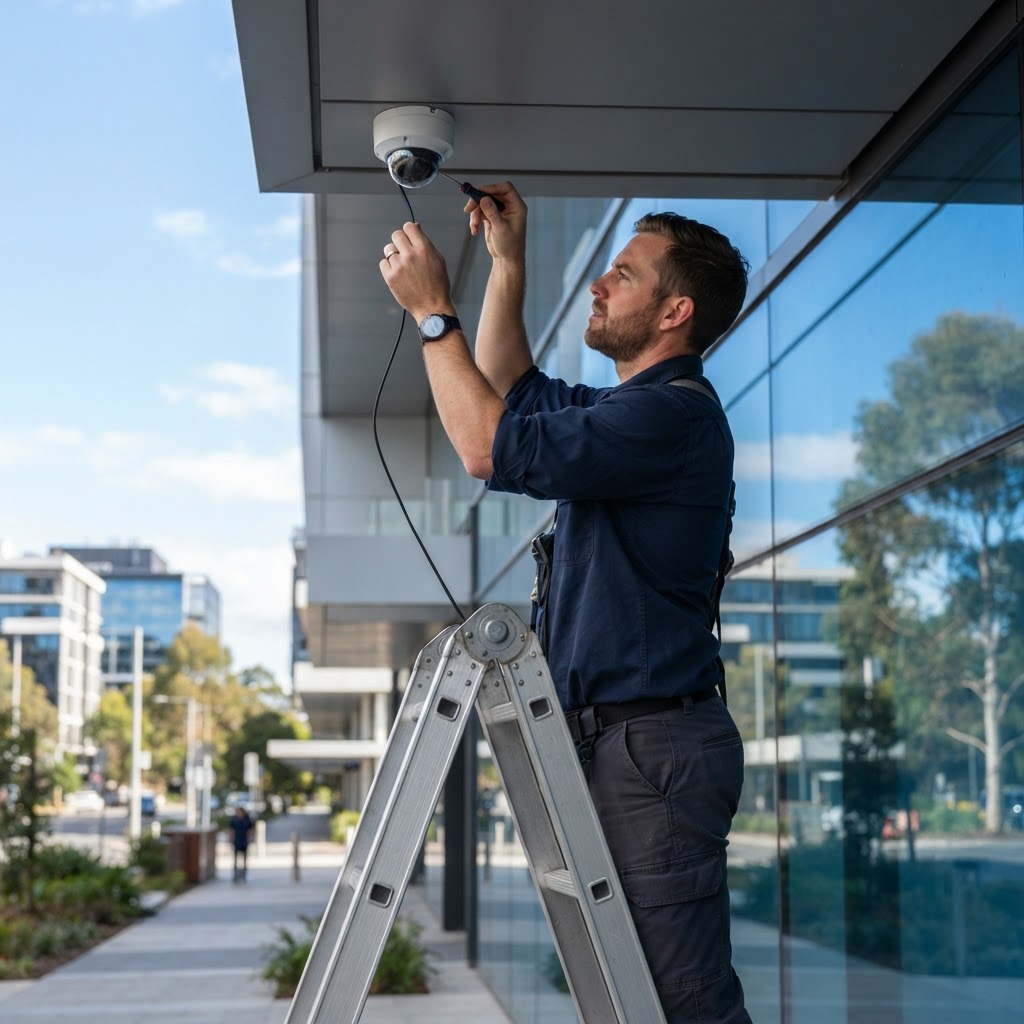
A CCTV system is only as good as its camera placement. We see it constantly across Western Sydney and the Blue Mountains: businesses that bought good cameras but mounted them in the wrong spots — facing the wrong angle, blinded by headlights, or watching a car park while the loading dock sits uncovered. Poor placement turns an expensive system into a decoration.
Whether you run a shopfront in Penrith, a warehouse in Blacktown's industrial area, a building site in Parramatta or a business in Katoomba, these camera placement tips will help your system capture what matters when it matters.
1. Cover Every Entry and Exit First
The single most important camera rule: capture everyone who enters or leaves. That means every door, gate and vehicle entry — not just the front. Most break-ins in commercial premises happen through rear or side entries precisely because that's where camera coverage is weakest.
- Front and rear doors (capture faces, not just tops of heads)
- Vehicle gates and roller doors
- Staff and delivery entrances
- Fire escapes and side paths
2. Get the Height Right
Cameras mounted too low get vandalised; too high and you get a bird's-eye view of the tops of heads. The sweet spot for identifying people is roughly 2.5 to 3 metres — high enough to stay out of easy reach, low enough to capture facial detail. For vehicle entry points, position cameras to capture number plates as vehicles approach, not as they pass.
3. Avoid Backlighting and Glare
The most common placement mistake we see across Western Sydney sites: a camera pointed at a doorway during the day. Bright daylight behind the subject turns them into a silhouette, and identification becomes impossible. Where you can, angle cameras to avoid windows and doorways facing direct sun, or use wide dynamic range (WDR) cameras in high-contrast spots. The same problem applies at night — a camera aimed at oncoming headlights or a bright security floodlight will wash out the image.
4. Cover High-Value and High-Risk Areas
After entries, cover what a thief would actually target:
- Stock rooms, safes and cash-handling areas
- IT and communications rooms
- Tool stores and plant storage
- Loading docks and lay-down areas
- Car parks and customer approaches
5. Think in Overlaps, Not Single Views
A single camera can be defeated by an umbrella, a hood, or an angle change. Design coverage so that a person moving through the site passes through more than one camera's field of view. Overlapping coverage means one obscured camera doesn't create a blind spot — and it gives investigators continuity of movement, which is often more useful than one clear frame.
6. Don't Hide the Cameras — Deter With Them
There's a time and place for discrete cameras, but for most businesses visible cameras are a feature, not a flaw. A clearly visible camera at the entrance of a Springwood retail store or a Blacktown warehouse says "go somewhere else" before anyone tests the lock. Add signage at entries — it multiplies the deterrent effect at zero ongoing cost.
7. Building Sites Need a Different Approach
Construction sites around Penrith, Parramatta and the Blue Mountains growth corridors are theft magnets — tools, copper, plant and materials are quick targets in unattended yards. Camera placement on a building site should cover:
- All site gates and vehicle entries (the primary route for tool theft)
- Material lay-down and storage areas
- Scaffolding approaches and hoarding perimeters
- Plant equipment parking zones
- Site office and container storage
Because building sites often lack mains power and network cabling, consider solar-powered and wireless CCTV solutions that can be repositioned as the site layout changes through construction stages. Mount cameras on site infrastructure where possible, and protect them out of easy rock-throw range — camera vandalism is common on unattended sites.
8. Record Enough, and Keep the Clock Right
Placement determines what you capture; retention determines whether it's still there when you need it. We recommend at least 28 days of storage for commercial sites, and always check that the system's date and time are accurate — a timestamp that's off by hours can undermine the evidentiary value of otherwise perfect footage.
9. Placement Should Follow a Risk Assessment
The best camera plan isn't the one with the most cameras — it's the one that covers your site's actual risks. A professional security risk assessment identifies your vulnerable entries, your high-value assets and your blind approaches, then maps cameras against them. It usually costs less than the two or three wasted cameras it prevents.
10. Cameras Detect — Patrols Deter
Finally, remember what cameras don't do: they don't stop anything in progress unless someone is watching. Pairing well-placed CCTV with mobile patrols gives you the combination that actually works — footage after the fact, plus a visible, unpredictable presence that stops most incidents before they start.
Frequently Asked Questions
How many cameras does a small business need?
Most small commercial premises need 4–8 cameras: all entries and exits, plus coverage of high-value areas. The number depends entirely on layout — a long, thin warehouse in Blacktown needs different coverage to a compact Penrith shopfront.
What height should security cameras be mounted at?
Around 2.5–3 metres balances tamper resistance with usable identification. Avoid mounting under eaves where glare and weathering degrade the image over time.
Do I need CCTV cameras on a construction site?
Unattended building sites are among the most-targeted properties in Western Sydney. Wireless or solar CCTV on gates, material storage and plant parking areas is one of the most effective deterrents available — and it can move with your site as work progresses.
Can CCTV footage be used as evidence?
Yes — clear, time-stamped footage is regularly used in police investigations and insurance claims. Accurate date/time settings, adequate retention (28+ days) and proper camera placement all affect how useful your footage is.
What's more effective: CCTV or security guards?
They do different jobs. CCTV provides coverage, evidence and deterrence at low ongoing cost; guards and patrols provide a live response. Most commercial sites benefit from both: well-placed cameras plus randomised mobile patrols.
Statewide Protective Services designs and installs commercial CCTV across Western Sydney and the Blue Mountains. Contact us for a site assessment and a camera plan built around your actual risks.