Security isn't a set-and-forget exercise. Across the Blue Mountains, businesses face theft, vandalism, trespass and after-hours break-ins that cost thousands in property damage and lost stock every year.
For businesses in Katoomba, Springwood, Leura, Wentworth Falls, Penrith and Lithgow, the risks vary — but the principles of good security don't. A practical checklist helps you identify gaps before they become incidents.
At Statewide Protective Services, we conduct commercial security audits across the Blue Mountains every week. Here's the checklist we use to assess whether a business is adequately protected.
1. External Perimeter and Access Points
Start outside. Your perimeter is your first line of defence:
- Are all gates, fences and barriers in good repair?
- Are external doors solid-core and fitted with deadlocks?
- Are windows fitted with security screens or locks?
- Is your external lighting working and on a timer or sensor?
For businesses on the tourist strip in Katoomba or Springwood's retail precinct, low winter light and dense vegetation around rear access lanes create easy targets. Trim trees and shrubs to remove hiding spots.
2. Alarm System Functionality
Your alarm system is only useful if it works. Check:
- Is the alarm armed when the last person leaves?
- When was the last service? (Annual service recommended)
- Are all sensors, detectors and keypads functioning?
- Is the system connected to back-to-base monitoring?
- Has the battery backup been tested?
An unmonitored alarm is a noise-maker. A monitored alarm is a deterrent that triggers a coordinated response when something goes wrong. For Blue Mountains businesses in remote or semi-rural locations like Wentworth Falls and Hazelbrook, monitored alarm response is particularly important — police response times can be slow without a confirmed incident report.
3. CCTV Coverage
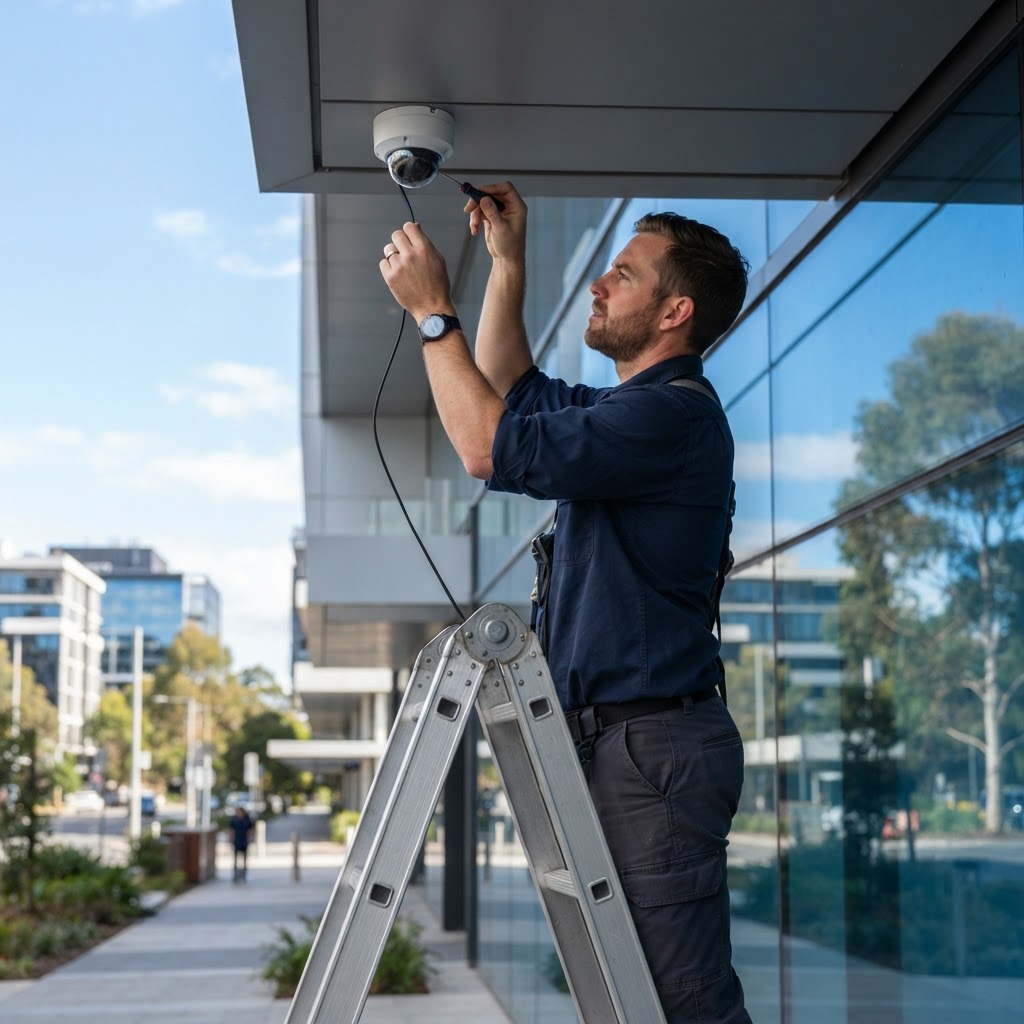
A well-designed CCTV system provides both live monitoring and post-incident evidence. Check:
- Are cameras covering all entry points, car parks and high-value areas?
- Is footage recorded and stored for at least 28 days?
- Are you using active monitoring (where unusual activity triggers an alert), or only passive recording?
- Are cameras positioned to capture faces, not just tops of heads?
- Is the system time-and-date stamped accurately?
For retail businesses in Leura and Katoomba where tourists and visitors create high foot traffic, monitored CCTV with remote activation alerts is a strong deterrent for opportunistic shoplifting and after-hours break-ins.
4. Key and Access Control Management
Lost keys are the most common cause of "burglary without forced entry". Review:
- Who holds keys or access fobs, and is the register current?
- Have keys been returned by departing staff or contractors?
- Is there a process for issuing and tracking temporary access (cleaners, tradies)?
- Should you consider electronic access control for high-traffic areas?
For businesses with multiple staff and contractors — particularly commercial sites in Penrith's industrial estate or construction sites in Lithgow — electronic access control is worth the investment.
5. Cash Handling Procedures
Cash is still the most common theft target across Blue Mountains retail. Review:
- Do you have a minimum-float policy visible at point of sale?
- Are tills emptied to a safe at close of business?
- Is the safe bolted to the floor and not visible from outside?
- Do you bank cash regularly rather than letting it accumulate?
- Do you have a procedure for cash handling during opening and closing times?
If you run a retail store in Springwood, Blackheath or Wentworth Falls, simple visible measures — keeping tills light, signage about cash handling, storing cash off-site overnight — reduce the appeal to opportunistic thieves.
6. After-Hours Risk
Most commercial break-ins across the Blue Mountains happen outside business hours. Ask:
- Who is responsible for locking up each night?
- Is there a locking-up checklist (doors, windows, alarm, lights, safe)?
- Are mobile patrols appropriate for your location and risk profile?
- Do you have an alarm response plan if your alarm activates overnight?
For sites that sit vacant overnight, weekends and public holidays — particularly in tourist-heavy areas where traffic spikes during school holidays — regular mobile patrols are a high-impact, low-cost deterrent.
7. Staff Training and Incident Reporting
Your staff are your eyes and ears during business hours. A good staff security protocol includes:
- Clear instructions on identifying suspicious behaviour
- A simple incident reporting process (written or digital)
- Regular security briefings (quarterly is good practice)
- Protocols for handling aggressive customers or incidents
For hospitality venues and retail stores across the Blue Mountains, well-trained staff are often the difference between an incident prevented and an incident reported after the fact.
8. Security Risk Assessment
The most valuable step on this checklist is an independent security risk assessment conducted by a licensed security professional. An external assessment:
- Identifies gaps that internal staff often miss
- Provides a prioritised action plan matched to your risk profile
- Is required by some insurers and licensing bodies
- Often reduces insurance premiums when completed annually
For Blue Mountains businesses dealing with seasonal tourism surges, remote site locations or high-value stock, an annual risk assessment should be standard practice — not an optional extra.
Reviewing Your Score
If you can answer 'yes' to most of these checklist items, your business is reasonably well-protected. If you've identified gaps, the next step is simple — arrange a practical security review with Statewide Protective Services. We'll walk through your premises with you, identify any gaps and work with you to close them.
Frequently Asked Questions
How often should a business security checklist be reviewed?
At minimum, review your commercial security checklist annually. For high-risk sites or those that have had a recent incident, review quarterly. Seasonal Blue Mountains businesses should review before peak trading periods (Christmas, school holidays, long weekends).
What's the difference between CCTV monitoring and passive CCTV recording?
Passive CCTV records footage but doesn't alert anyone to an incident in real time. Monitored CCTV uses technology and human oversight to detect unusual activity and trigger a response — giving you the chance to intervene before a break-in or incident escalates.
Are mobile patrols effective for commercial sites in the Blue Mountains?
Yes. Mobile patrols are particularly effective for sites that sit vacant overnight or in remote/semi-rural locations. A uniformed officer arriving at varying times creates a visible, unpredictable deterrent that makes your site a harder target.
How long does a security risk assessment take?
A standard commercial risk assessment takes 1-2 hours on site, depending on the size of the premises. The written report is usually delivered within 2-3 business days.